The one in central Vienna also went up in 1945 within months of the end of the war. Locals refer to it rather unkindly as the 'Monument to the Unknown Looter'. The memorials gave the Russians a useful foothold in the West, with guards stationed by the one in Berlin, while Putin was a regular visitor to Vienna's. If he goes back now, he'll find the huge wall at the back has been painted in the colours of Ukraine.
Monday, 22 September 2025
I-Spy Vienna. The Russian War Memorial
Monday, 29 April 2024
I-Spy Turin: memorial to a forgotten front
The war memorial in Turin, pictured above, commemorates soldiers killed in one of them, the conflict between Austria and Italy, much of which was fought on the Alpine Front.
Italy entered the war late, in 1916. Having been an ally of the Austro-Hungarian Empire, it switched sides to join Britain, France and Russia. Austria and Italy would lose a million men - 600,000 Italians and 400,000 Austrians - many of them in the mountains. One war correspondent said conditions there were worse even than 'in the blood-soaked mud of Flanders'.
In addition to the cold and the usual hazards of war, there were avalanches, sometimes set off deliberately as a weapon, sometimes triggered accidentally by artillery, and sometimes occurring naturally. After heavy snow in December of 1916, avalanches buried 10,000 soldiers in just two days.
Tuesday, 19 March 2024
I-Spy Paris: war memorial to the Tsar's troops
In 1916, Tsar Nicholas II of Russia sent 20,000 Russian troops to help France fight the Germans on the Western Front. Above is the memorial in Paris to the 5,000 who were killed.
Tsarist Russia was part of the Triple Entente with France and Britain, lining up against the Central Powers of Germany, the Austro-Hungarian Empire and the Ottoman Empire.
Tsar Nicholas would be killed by the Bolsheviks as the Russian Empire collapsed. The First World War also brought an end to the German Empire, and the Austro-Hungarian and Ottoman Empires were dismantled.
Monday, 3 November 2014
Remembering World War One
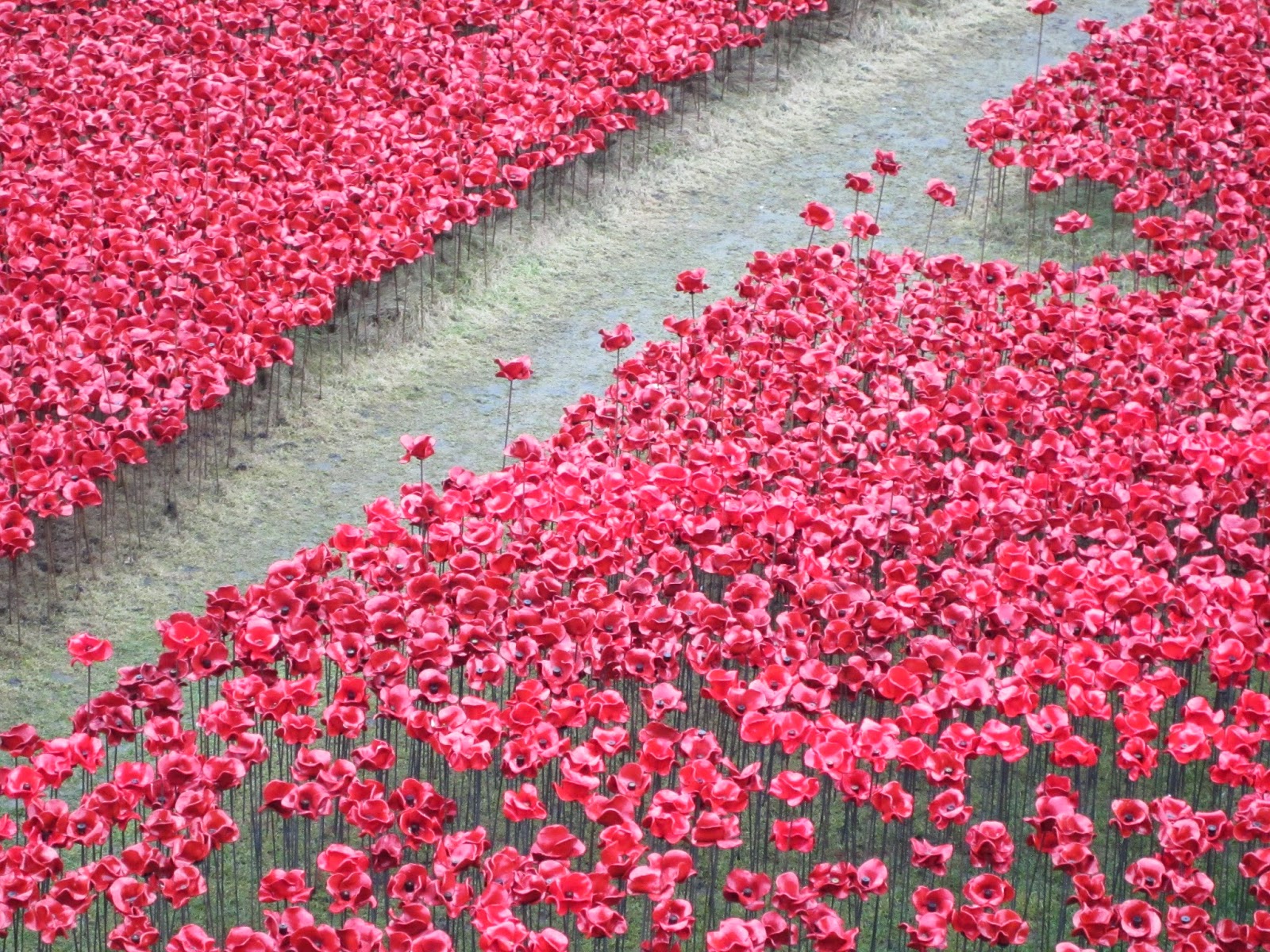
Went to the Tower of London yesterday to see the 888,246 ceramic poppies planted in the moat - each one representing a British military death in World War One. Although I arrived early, there were already hundreds of people there.
In spite of the precision on British losses implied by the number of poppies at the Tower, there is much less certainty about overall casualties in the Great War, partly because of the immense social dislocation the conflict brought, with four of the combatants facing revolutions around its end.
Estimates put the total number of military deaths at more than 8 and a half million, with Germany and Russia each suffering about one and three quarter million, and Austria-Hungary and France each losing well over a million.
Coming up with an authoritative figure for the civilians who perished through massacre, accident, disease, hunger, exposure and hardship is even more difficult, but some estimates put the number even higher than that for military casualties, at around 13 million.
Saturday, 28 June 2014
Sarajevo 1914 - a bizarre chapter of accidents
Sunday, 15 April 2012
Soldiers and avalanches
Friday, 18 September 2009
Dubrovnik
The famous city walls and some notable buildings survived, like the Sponza Palace, the Rector's Palace and St Saviour's Church. I was disappointed to see how many of the churches were locked, without any apparent information as to when they would open.
The earthquake hit Dubrovnik when it was a prosperous independent republic, but it never really recovered, and in 1802 it was conquered by Napoleon, and then handed over to the Austrian Empire after the French Emperor's defeat.
In more recent times, Dubrovnik got caught up in Yugoslavia's civil war, and was struck by 2,000 shells during 1991-2. The Sponza and Rector's Palaces were seriously damaged as were two in three of the city's characteristic red-roofed houses. Outside the old city, many walls still bear the marks of bullets and shrapnel.
Sunday, 28 June 2009
A sombre anniversary
Princip, a 19 year old Bosnian Serb, wanted to liberate the whole of the Balkans from Austro-Hungarian rule. While Franz Ferdinand was on a visit to the Bosnian capital, then part of Austria's empire, one of Princip’s comrades threw a bomb at his car. It bounced off and exploded beneath the next vehicle, injuring two of the occupants and about a dozen people in the crowd. While the Archduke and his wife were on their way to a hospital to visit the injured, Princip shot them.
While the First World War was raging, Princip was tried and sentenced to 20 years in gaol – the maximum allowed for someone under 20 – on October 28, 1914. He was kept in harsh conditions and died of tuberculosis in April 1918.
The Treaty of Versailles was signed exactly five years after the assassination on June 28, 1919. The war is estimated to have cost the lives of about 8.5 million military personnel, and perhaps 13 million civilians from starvation, disease, being caught up in military action or massacre. It also put paid to the Austro-Hungarian empire.