Showing posts with label British. Show all posts

Wednesday, 18 May 2016

Europe: stay or leave? Focus on fact - 6


Today’s fact: leaving Europe is not just for Christmas.

Interesting to hear some people inclined to vote for Brexit on the radio yesterday morning. They were asking: ‘if we leave Europe and it all goes wrong, when do we get the chance to join again? Is it in 3 years or in 5 years?’ The fact that the answer to the question is ‘probably never’ and that Brexit is a one-way ticket, does not seem to have dawned on some of the anti-Europeans.

Interesting also the way the anti-Europeans dismiss the overwhelming weight of reputable, statistically supported economic forecasts that leaving Europe will damage us, and that the only question is how much. The Brexiters reply: ‘forecasts are nearly always wrong’. And yet they base their own arguments on completely unsupported forecasts that the EU is going to (a) get closer and closer or (b) break up. As these forecasts are contradictory, plainly at least one cannot be right.

And even if either should one day come to pass, neither is a reason for leaving now. Should the EU get closer and closer, we are exempt from the process, and if we should ever feel our exemption was insufficient, we could then leave. Similarly, if the EU were to break up, we would, like everyone else, leave.


The anti-Europeans are behaving like a man on a cliff top who jumps off because he is afraid that at some time in the future a dangerous animal may appear.

Sunday, 3 April 2016

Europe - stay or leave? Focus on Fact - 1


I am getting increasingly depressed at the way the UK's Europe referendum debate has become a fact-free zone. We can expect no help from popular newspapers. Most have given up any pretence of covering the EU objectively and have simply become anti-European propaganda sheets. So I will be posting regularly on the facts.

Some recent development:-

1)This week I heard a couple of anti-Europeans on the radio blaming the plight of the British steel industry on the EU. Now it has been revealed that the EU wanted to take action against the dumping of Chinese steel, but the UK government has been blocking it: http://www.independent.co.uk/news/uk/politics/tata-steel-uk-government-accused-of-failing-to-protect-british-workers-by-blocking-eu-plans-to-allow-a6962446.html

2) Even the pro-Brexit Daily Telegraph has had to admit that Boris Johnson doesn’t know what he is talking about on Europe. http://www.telegraph.co.uk/news/politics/12186288/Boris-is-wrong-Britain-will-be-protected-from-the-maw-of-a-EU-superstate.html


More soon!

Monday, 3 November 2014

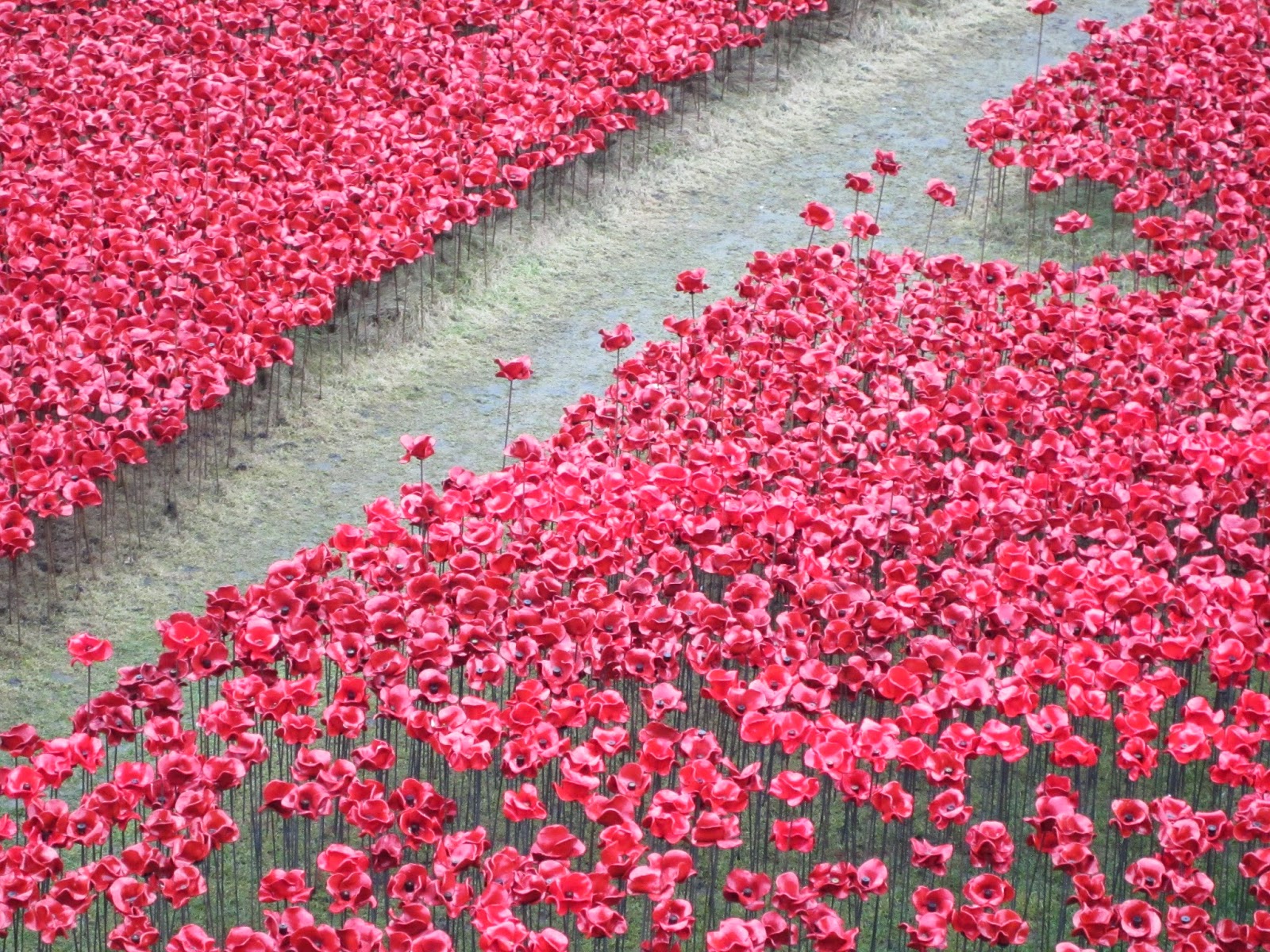
Remembering World War One


Went to the Tower of London yesterday to see the 888,246 ceramic poppies planted in the moat - each one representing a British military death in World War One. Although I arrived early, there were already hundreds of people there.

In spite of the precision on British losses implied by the number of poppies at the Tower, there is much less certainty about overall casualties in the Great War, partly because of the immense social dislocation the conflict brought, with four of the combatants facing revolutions around its end.

Estimates put the total number of military deaths at more than 8 and a half million, with Germany and Russia each suffering about one and three quarter million, and Austria-Hungary and France each losing well over a million.

Coming up with an authoritative figure for the civilians who perished through massacre, accident, disease, hunger, exposure and hardship is even more difficult, but some estimates put the number even higher than that for military casualties, at around 13 million.

Thursday, 8 December 2011

Britain's 20 Worst Military Disasters 10 - The Castlebar Races


The Irish Rebellion of 1798 was on its last legs when a mini French army of just over 1,000 men, led by animal skin dealer turned revolutionary general Joseph Humbert, landed near Killala in County Mayo.

Skilfully avoiding British forces, the French plus a few Irish recruits they had managed to pick up, found themselves early on the morning of August 27 before the walls of Castlebar, County Mayo’s county town, where they finally faced the enemy.

It should have been no contest.   The British had cavalry and artillery with a range of 1,000 yards.  The French had only muskets effective at 100, but they managed to launch a ferocious bayonet charge.

Was it the fact that a new British commander had arrived just hours before the attack?   Was it that many in their ranks secretly sympathised with the rebel cause?    Whatever the reason, the British force fled from the field with such speed and enthusiasm that the encounter was dubbed ‘the Castlebar Races.’    The full story is in Britain’s 20 Worst Military Disasters.

Thursday, 24 November 2011

Britain's 20 Worst Military Disasters 8 - the Siege of Cartagena de Indias


The Spaniards often call it ‘the Defeat of the British Armada’.    In 1741, during the wonderfully-named ‘War of Jenkins’ Ear’, the British dispatched the biggest force they had ever sent to the West Indies – 10,000 men and more than 20 ships - to join the fleet already out there under Vice-Admiral Edward Vernon.

The objective was to capture Spain’s fortress of Cartagena de Indias in modern-day Colombia, but right from the start, things went wrong.    The army commander, Lord Cathcart, and 600 of his men died from sickness on the way out.   

Then once the force arrived, a feud broke out between Cathcart’s replacement, the inexperienced Sir Thomas Wentworth, and Vernon, while the Spanish defences were cleverly organised by Admiral Blas de Lezo, nicknamed ‘half-man’, who had lost an arm, a leg and an eye in the service of his country.

A number of British assaults failed, while sickness continued to take a terrible toll.   When only 1,700 of the 10,000 who left Britain were still fit for duty, the assault was called off, and the country’s first Prime Minister, Sir Robert Walpole, was forced to resign.

Wednesday, 11 February 2009

Measles

Measles is on the increase again in Britain – with the number of cases in England and Wales rising from 990 in 2007 to at least 1,348 last year. The Health Protection Agency says the reason is that fewer people had their children vaccinated because of a scare, which most doctors now discount, over the MMR vaccine.

In 2006, a 13 year old boy became the first person to die from the virus in the UK in 14 years, and he had been taking an immunosuppressive drug. Across the world, though, the disease can be deadly and in 2007, the World Health Organisation said it had killed nearly 200,000. That in itself was a huge decrease from the figure for the year 2000 of 750,000.

As Europeans took over the world from the fifteenth century onwards, the measles virus was one of the deadliest weapons they carried with them. It was estimated to have killed two million Mexican Indians in the 1600’s, and it also cut a swath through the North American Indians. In 1847, the victims were the Cayuse Indians who lived in Oregon and Washington, and soon after they were defeated in war and confined to a reservation.

Between 1875 and 1911 three epidemics hit Fiji, after the virus was thought to have been brought to the islands by a leading local dignitary who had been to Australia to discuss handing them over to the British. The first and deadliest outbreak killed perhaps 40,000 out of a population of 150,000. The two later epidemics tended to kill young people who had been born since the previous visitation, and so had not acquired immunity.

Wednesday, 21 January 2009

Perils of queueing + debut of a mass murderer

An Australian behavioural economist (!), David Savage has analysed the figures for those who died when the Titanic sank on April 15, 1912, and discovered that American passengers were 8.5% more likely to survive than those from other countries, and British passengers 7% less likely. He seems to put this down to the idea that the British formed orderly queues to get into the lifeboats (which did not have enough space for everyone on board) while the Americans behaved, as one newspaper delicately put it, in a “brasher” way. The study concludes that even the Americans, though, were not beastly to female passengers. Women were, on the whole, allowed to get into the boats first, and there was little difference between the survival prospects for Britons and Americans.

Mr Savage concedes, however, that there might be another explanation for the figures. We know that passengers in first and second class had a much better chance of getting away than those in steerage. Only one child in first and second class died, while two out of three of those in steerage perished. Maybe there were just fewer Americans travelling steerage. Overall, after analysing four disasters, the behavioural economist comes up with the reassuring thought that "the whole concept of mass panic – everyone looking after themselves – doesn't hold that strong."

On this day......85 years ago, the creator of the Russian Revolution, Vladimir Ilyich Lenin, died. Although he tried to prevent it, he was succeeded by Josef Stalin, who, through doctrinaire economic policies, purges, reigns of terror and fearsome labour camps, was responsible for the deaths of perhaps 30 million people, making him one of the greatest mass murderers in history.