Saturday, 11 June 2016
Europe: stay or leave? Focus on fact - 10
Thursday, 15 January 2015
Terrorism: Remember Paris....but don't forget Nigeria
Friday, 21 November 2014
Birmingham pub bombings + 40. Who were the killers?
Sunday, 10 August 2014
The Yazidis - a history of persecution
Thursday, 7 August 2014
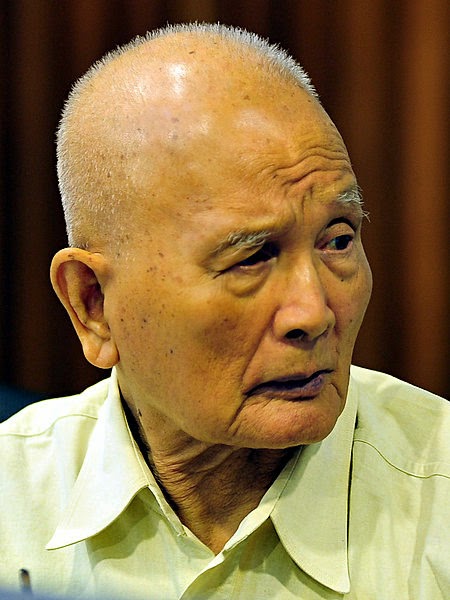
Two Khmer Rouge convicted of mass murder
Wednesday, 7 May 2014
Who remembers the Armenians? Many people
Friday, 11 April 2014
Rwanda + 20
Wednesday, 18 December 2013
Joseph Stalin - unhappy birthday
On this day........134 years ago, Joseph Stalin was born. The Russian Communist dictator went on to be one of the greatest mass murderers in history, being responsible for the deaths of perhaps 30 million people.
In 1928, he embarked on a forced collectivisation of Soviet agriculture, but millions of peasants would have nothing to do with it, often slaughtering their animals rather than hand them over to the state. Hundreds of thousands of villagers died as they were marched off to Siberia.
Even when famine swept through the Ukraine in 1932, the government carried on seizing grain from farmers. How many died? ‘No one was counting’, shrugged Khrushchev, then one of Stalin’s aides. An official estimate in 1990 put the number at four million, but many believe it was far more.
Then came the purges - intellectuals, artists, engineers, army officers, police chiefs, communist officials, people who had made an unwise comment. Millions were sent to the gulags, where the commandants were given a quota of inmates - 28% - who had to be shot or otherwise punished for anti-state agitation.
For more, see A Disastrous History of the World.
Friday, 1 June 2012
Two war criminals sentenced
Tuesday, 20 September 2011
London's deadliest post-war fire
Thursday, 4 August 2011
Yugoslav war crimes - job done?
Friday, 15 July 2011
Target Mumbai
Monday, 27 June 2011
Woman gaoled for Rwanda genocide
Saturday, 14 May 2011
World War Two - last war crimes trial?
Monday, 9 May 2011
Congo genocide - trials in Germany
Wednesday, 6 April 2011
Bangladesh - war crimes trials stall
The war that brought independence for Bangladesh (then East Pakistan) ended in 1971. Estimates of the number of lives lost range up to 3 million – many murdered in cold blood by the West Pakistan army - and perhaps 10 million people fled their homes.
Over the last few months, there have been attempts to call to account some of those responsible for atrocities during the conflict. The authorities are not going after the West Pakistan army, but alleged local collaborators who helped them.
Dozens of suspects are banned from leaving the country, and the war crimes tribunal has issued arrest warrants against five party leaders, including two former ministers, though they are not charged with war crimes, and unfortunately, the whole process has become mired in inter-party political rivalries.
The general belief is that if the opposition wins the next general election, due in 2013, it will scrap the war crimes trials, and they are the favourites. No democratic government in Bangladesh’s short history has ever won a second term.
Saturday, 11 December 2010
Rwanda genocide - preserving history
An archive of the Rwanda genocide of 1994 has just opened at the Kigali Genocide Memorial in the country’s capital. It includes thousands of documents, photographs and video and sound recordings collected from survivors, witnesses and perpetrators of the mass murder.
It’s a joint initiative by the Rwandan government and the Aegis Trust, which works to prevent genocide and crimes against humanity, and the memorial site is on slopes above mass graves believed to hold the bodies of up to a quarter of a million victims.
The site’s director, himself a survivor of the genocide says that many people in Rwanda still deny the genocide, and that the archive will help ‘fight them with facts.’ The Aegis Trust is also working with the UK’s University of Nottingham to create a comprehensive map of Rwanda’s genocide sites. So far more than 1,000 have been identified in Kigali alone.
The Rwanda genocide, during which Hutu extremists murdered moderate Hutus and Tutsis was the most rapid in history, with 800,000 people murdered in 100 days. (See also my blogs of Jan 23, March 1, 4, 23; April 9, July 16, May 6, Sept 3, 9, 23; Oct 8, 30; Dec 15, 2009, 25 Feb, 2010.)
Monday, 18 October 2010
Mumbai appeal
The only surviving gunman from the 2008 terrorist attacks in Mumbai has begun his appeal against the death sentence. 23 year old Mohammad Ajmal Amir Qasab, a Pakistani national, was one of ten assailants who caused the deaths of more than 170 people.
Qasab and an accomplice carried out the attack on the city’s main railway station, killing 52 people. In May, he was found guilty of mass murder and waging war against India.
For security reasons, the convicted man is appearing via video link from his prison. Reporters in the courtroom say he smiled frequently as he looked into the camera. The hearing is expected to last three months.
(See also my blogs of July 23 and Nov 26, 2009.)
Thursday, 16 September 2010
Another Khmer Rouge trial
Less than two months after the conviction of former Khmer Rouge prison boss Comrade Duch (see my blog of July 26), another four of its leaders have been indicted for genocide and torture in Cambodia in the 1970’s.
Duch was the first person convicted by the UN-backed war crimes court. Now Nuon Chea, deputy to the notorious KR leader Pol Pot, former head of state Khieu Samphan, former foreign minister Ieng Sary and his wife Ieng Thirith will come before it. All of them deny the charges.
Justice has been a long time coming. The events to which the charges relate took place more than 30 years ago. The defendants have all been held since 2007, and the trial is not expected to start before the middle of next year. All of them are now elderly, and Ieng Sary is in poor health.
The Cambodian genocide was one of the most vicious in history, accounting for perhaps one in four of the country’s people. Apart from those who were murdered – “bourgeois” elements such as lawyers, doctors, teachers, engineers, scientists and their families - many others died from hunger or overwork, as Pol Pot’s Maoist fanatics emptied the cities and drove people out into the countryside.
(See also my blogs of Jan 7, March 4, June 29 and Nov 22, 2009.)
Thursday, 9 September 2010
Genocide begets genocide?
The Rwandan government’s threat to withdraw its 3,400 personnel serving with the UN-African Union peacekeeping force in Darfur (see my blog of Sept 3) seems to have had the desired effect. UN Secretary-General Ban Ki-moon quickly jetted into the Rwandan capital, Kigali, to tell President Paul Kagame that he was “disappointed” about the leaking of a UN report accusing Rwandan forces of murdering tens of thousands of Hutus in the Congo.
A team from the UN’s office for the High Commissioner on Human Rights has catalogued more than 600 incidents, and it claims that President Kagame’s Hutu forces were involved in more than 100 of them.
In 1996, for example, Rwandan troops are said to have gone to the Chimanga refugee camp. They told the refugees they would be going back home. Then, on an apparently pre-arranged signal, they opened fire, killing up to 800.
Back in 1994, it was President Kagame’s Rwandan Patriotic Front that put an end to the mass murder of Tutsis by extremist Hutus in Rwanda. Many of the perpetrators fled to the Congo, where they hid among a million other Hutus who had fled fearing for their lives under the new regime. It was when the genocide organisers started re-grouping that President Kagame ordered the invasion.