Saturday, 26 March 2016
20 years on - Karadzic convicted
Tuesday, 28 July 2015
Srebrenica - the battle over its history
Twenty years ago this month, 8,000 Bosnian Muslims were murdered by Serb forces at Srebrenica in the worst mass murder in Europe since World War Two. It was condemned as genocide by the UN war crimes tribunal in The Hague, and also by the International Court of Justice.
But Serb leaders deny the massacre was genocide, arguing that Serb victims of the wars that followed Yugoslavia's break-up have been forgotten, and a recent UN Security Council resolution denouncing it was vetoed by Russia.
Today Bosnia is split between Serb, Bosnian and Croat run sectors. Bosnian children learn all about the massacre, while Bosnian Croat children hear little about it, and Bosnian Serb children are taught that its mastermind, Ratko Mladic, currently on trial at The Hague, was a hero.
Srebrenica has never recovered, but one bright spot in the story is the absence of inter-communal revenge killings, though worryingly last month ISIS released a video calling on Balkan Muslims to murder their non-Muslim neighbours.
Thursday, 14 May 2015
Burundi - forgotten tragedy
For Rwanda genocide, see my blogs of 29 May 2011, 31 March and 1 June 2012, 1 June 2013, and 15 March 2014.
Wednesday, 29 April 2015
Who remembers the Armenians?
'Who remembers the Armenians?' was supposed to have been Hitler's scornful question to his commanders as he urged them to be pitiless to the people of Poland on the eve of the German invasion in 1939. He was referring to the massacre of the Armenian Christian minority in the Turkish Ottoman Empire 100 years ago.
A century on, the answer to Hitler's question seems to be: 'quite a lot of people.' Over the past week, remembrance ceremonies have been held all over the world, and the French president, Francois Hollande, urged Turkey to recognise the massacre of up to 1.5 million people as genocide.
Turkey's president said his country 'shared the pain' of the Armenians, but rejected the suggestion that the killings were part of a systematic campaign, and said that many innocent Muslims also perished during the horrors of the First World War.
The fate of the Armenians has long been a subject of bitter controversy in Turkey. In 2006, Orhan Pamuk, the first Turk to win the Nobel Prize for literature, was charged with'insulting Turkish identity' when he referred to the massacre, and the following year, a journalist of Armenian descent was shot dead in Istanbul after he described it as 'genocide'.
Friday, 24 October 2014
Who killed who in Rwanda?
Twenty years after the genocide in Rwanda in which up to a million people were murdered in 100 days, the Rwandan government wants to prosecute the BBC over a television programme which challenges the accepted view of what happened.
The conventional wisdom is that Hutu extremists massacred mainly Tutsis as well as some Hutu moderates. The programme, Rwanda: the Untold Story, includes contributions from an academic who argues that there were only about 500,000 Tutsis in the country, and that 300,000 survived, so most of the victims must have been Hutus.
Prof Allan Stam paints a picture of a general breakdown in law and order, and says most of the victims may have been Hutus. When he presented his findings, the government rejected them, and he was asked to leave the country.
The genocide was sparked by the mysterious shooting down of the president's private jet. The programme includes allegations that Rwanda's current president, Paul Kagame, a Tutsi, was behind the attack, but he has always denied such allegations, and blamed Hutu extremists.
Thursday, 7 August 2014
Two Khmer Rouge convicted of mass murder
Wednesday, 7 May 2014
Who remembers the Armenians? Many people
Friday, 11 April 2014
Rwanda + 20
Saturday, 15 March 2014
Rwanda genocide - first conviction in France
Sunday, 17 November 2013
Cambodia - justice and killing fields
Bringing alleged war criminals to justice decades after the event is never a straightforward process, and it has proved particularly difficult in Cambodia, where up to 2 million people, a quarter of the country’s population at the time, perished during Pol Pot’s 1970’s reign of terror.
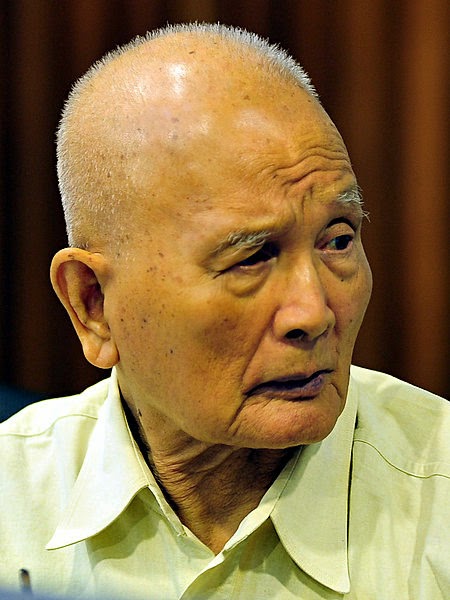
Last month, the last two surviving leaders of the Khmer Rouge regime made closing statements at their trials. ’Brother Number Two’, 87 year old Nuon Chea (pictured) and Khieu Samphan, aged 82, the regime’s head of state, both deny crimes against humanity. A verdict is expected early next year, and they are still due to face genocide charges at some future date.
Nuon Chea expressed remorse for the suffering endured by the Cambodian people, but blamed it all on subordinates. The only leader convicted so far is Kaing Guek Eav, known as Duch, who admitted charges against him. (see my blog of 26 July, 2010) Another defendant, Ieng Sary, died in March, while his wife was ruled unfit to continue her trial. (see my blog of 16 March)
The country’s prime minister, Hun Sen, was himself a Khmer Rouge battalion commander, and the government has often seemed less than enthusiastic about the court, but more than 100,000 Cambodians have attended the hearings.
Saturday, 1 June 2013
Rwanda 1994 genocide - more arrests
Saturday, 25 May 2013
Darfur - lest we forget
Saturday, 16 March 2013
Cambodia - Justice delayed..................
Friday, 1 June 2012
Two war criminals sentenced
Monday, 27 June 2011
Woman gaoled for Rwanda genocide
Sunday, 29 May 2011
War crimes arrests - Serbia and Rwanda
Monday, 9 May 2011
Congo genocide - trials in Germany
Saturday, 11 December 2010
Rwanda genocide - preserving history
An archive of the Rwanda genocide of 1994 has just opened at the Kigali Genocide Memorial in the country’s capital. It includes thousands of documents, photographs and video and sound recordings collected from survivors, witnesses and perpetrators of the mass murder.
It’s a joint initiative by the Rwandan government and the Aegis Trust, which works to prevent genocide and crimes against humanity, and the memorial site is on slopes above mass graves believed to hold the bodies of up to a quarter of a million victims.
The site’s director, himself a survivor of the genocide says that many people in Rwanda still deny the genocide, and that the archive will help ‘fight them with facts.’ The Aegis Trust is also working with the UK’s University of Nottingham to create a comprehensive map of Rwanda’s genocide sites. So far more than 1,000 have been identified in Kigali alone.
The Rwanda genocide, during which Hutu extremists murdered moderate Hutus and Tutsis was the most rapid in history, with 800,000 people murdered in 100 days. (See also my blogs of Jan 23, March 1, 4, 23; April 9, July 16, May 6, Sept 3, 9, 23; Oct 8, 30; Dec 15, 2009, 25 Feb, 2010.)
Thursday, 16 September 2010
Another Khmer Rouge trial
Less than two months after the conviction of former Khmer Rouge prison boss Comrade Duch (see my blog of July 26), another four of its leaders have been indicted for genocide and torture in Cambodia in the 1970’s.
Duch was the first person convicted by the UN-backed war crimes court. Now Nuon Chea, deputy to the notorious KR leader Pol Pot, former head of state Khieu Samphan, former foreign minister Ieng Sary and his wife Ieng Thirith will come before it. All of them deny the charges.
Justice has been a long time coming. The events to which the charges relate took place more than 30 years ago. The defendants have all been held since 2007, and the trial is not expected to start before the middle of next year. All of them are now elderly, and Ieng Sary is in poor health.
The Cambodian genocide was one of the most vicious in history, accounting for perhaps one in four of the country’s people. Apart from those who were murdered – “bourgeois” elements such as lawyers, doctors, teachers, engineers, scientists and their families - many others died from hunger or overwork, as Pol Pot’s Maoist fanatics emptied the cities and drove people out into the countryside.
(See also my blogs of Jan 7, March 4, June 29 and Nov 22, 2009.)
Thursday, 9 September 2010
Genocide begets genocide?
The Rwandan government’s threat to withdraw its 3,400 personnel serving with the UN-African Union peacekeeping force in Darfur (see my blog of Sept 3) seems to have had the desired effect. UN Secretary-General Ban Ki-moon quickly jetted into the Rwandan capital, Kigali, to tell President Paul Kagame that he was “disappointed” about the leaking of a UN report accusing Rwandan forces of murdering tens of thousands of Hutus in the Congo.
A team from the UN’s office for the High Commissioner on Human Rights has catalogued more than 600 incidents, and it claims that President Kagame’s Hutu forces were involved in more than 100 of them.
In 1996, for example, Rwandan troops are said to have gone to the Chimanga refugee camp. They told the refugees they would be going back home. Then, on an apparently pre-arranged signal, they opened fire, killing up to 800.
Back in 1994, it was President Kagame’s Rwandan Patriotic Front that put an end to the mass murder of Tutsis by extremist Hutus in Rwanda. Many of the perpetrators fled to the Congo, where they hid among a million other Hutus who had fled fearing for their lives under the new regime. It was when the genocide organisers started re-grouping that President Kagame ordered the invasion.


.jpg)