Showing posts with label Cambodia. Show all posts

Thursday, 7 August 2014

Two Khmer Rouge convicted of mass murder


Almost 40 years after the mass murder by the Khmer Rouge in Cambodia that left perhaps a quarter of the population dead, two of the regime’s leading lights have been sentenced to life imprisonment.

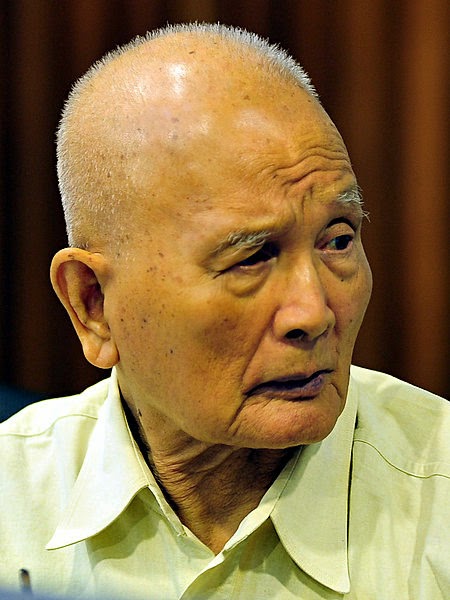
88 year old Nuon Chea (pictured) served as the notorious Pol Pot's deputy, while Khieu Samphan, now aged 83, was head of state. The judge said they were guilty of ‘extermination encompassing murder, political persecution, and other inhumane acts.’
The Maoist regime’s speciality was to drive people out of the cities and force into the countryside, where they were worked or starved to death. Many in Cambodia have criticised the slow pace at which justice has proceeded, and a judge resigned in 2012, complaining that investigations into suspects were being blocked.

The convicted pair deny the offences and say they will appeal, though they will remain in gaol. They could also face a further trial on charges of genocide.

Sunday, 17 November 2013

Cambodia - justice and killing fields


Bringing alleged war criminals to justice decades after the event is never a straightforward process, and it has proved particularly difficult in Cambodia, where up to 2 million people, a quarter of the country’s population at the time, perished during Pol Pot’s 1970’s reign of terror.

Last month, the last two surviving leaders of the Khmer Rouge regime made closing statements at their trials. ’Brother Number Two’, 87 year old Nuon Chea (pictured) and Khieu Samphan, aged 82, the regime’s head of state, both deny crimes against humanity. A verdict is expected early next year, and they are still due to face genocide charges at some future date.

Nuon Chea expressed remorse for the suffering endured by the Cambodian people, but blamed it all on subordinates. The only leader convicted so far is Kaing Guek Eav, known as Duch, who admitted charges against him. (see my blog of 26 July, 2010) Another defendant, Ieng Sary, died in March, while his wife was ruled unfit to continue her trial. (see my blog of 16 March)

The country’s prime minister, Hun Sen, was himself a Khmer Rouge battalion commander, and the government has often seemed less than enthusiastic about  the court, but more than 100,000 Cambodians have attended the hearings.

Monday, 29 April 2013

Malaria - a pugnacious parasite


New drug-resistant strains of the parasite that causes malaria have been identified in western Cambodia.    There have been reports of drug resistance in the region since 2008, and the problem has now spread to other parts of South-east Asia.

Scientists investigating the new organism say that all the most effective drugs developed in the last few decades ‘have been one by one rendered useless by the remarkable ability of this parasite to mutate and develop resistance.’   They do not know why this part of Cambodia should be such a hotbed of resistance.

In 2010, there were more than 200 million cases of malaria and 600,000 deaths – 90 per cent of them in Africa.   The World Health Organisation has made preventing the spread of resistant strains a major objective.  

See also my blogs of 11 April, 30 May, and 24 Sept, 2009; 21 Oct, 2010; 23 Sept, 2011 and 23 May, 2012.

*I’ve just started to post a series of videos on Britain’s 20 Worst Military Disasters.   This is the first -  https://www.youtube.com/watch?v=D0Bgf-xHHGE

Saturday, 16 March 2013

Cambodia - Justice delayed..................


‘Justice delayed is justice denied’, goes the old saying.   Its truth was dramatically illustrated this week when Ieng Sary, so-called Brother Number 3, died during his trial for his part in the Khmer Rouge’s campaign of mass murder in Cambodia in the 1970’s.

Ieng Sary, who had been the Khmer Rouge’s foreign minister, was aged 87 and in poor health.  He had denied the charges against him.     During the regime’s reign of terror, up to 1.75 million people, a quarter of Cambodia’s population, were exterminated.

So far, only one person has been convicted for his role in these events. Kaing Guek Eav, known as Comrade Duch, who was sentenced to 35 years in prison.   Proceedings against Ieng Sary’s wife, Ieng Thirith, were suspended when she was diagnosed with Alzheimer’s Disease.  Now following Ieng Sary’s death, there are only two remaining defendants, both of whom are frail and suffering from high blood pressure.  

Like Ieng Sary and Ieng Thirith, they have been in custody since 2007.  With Cambodians seeing the opportunity of calling to account those accused of participation in one of the worst crimes in history slipping away, the country’s Centre for Human Rights has urged the authorities to proceed as quickly as possible.

 (See also my blogs of 16 Sept, 2010 and 1 Feb, 2011.)

Wednesday, 23 May 2012

Fakes undermine fight against malaria


Recent successes in the fight against malaria are being undermined by the way counterfeit drugs have penetrated the supply chain in sub-Saharan Africa and south-east Asia.   American researchers examined 4,000 anti-malaria drug samples from 28 countries and found that a third were fake.

The problem is that not only do they fail to protect the people who take them, but they can also lead to resistant strains appearing, and the researchers think the problem may be even worse than their findings suggest.

Death rates from malaria have fallen by more than a quarter since 2000, but more than 3 billion people in 106 countries are still at risk, and up to 1.2 million die every year.

There has been concern in recent years over the emergence of resistance to the most effective drugs in western Cambodia.    (See also my blogs April 11, May 30, Sept 24, 2009 and Oct 21, 2010 and Sept 23, 2011.)

Friday, 7 October 2011

Thailand floods

More than 250 people have now been killed in the monsoon floods that have been affecting Thailand for the last two months.    Twenty-eight provinces have suffered, and more than two million people have had their lives disrupted.

These are said to be the worst floods in half a century, and the Prime Minister has warned that parts of Bangkok will soon be under water.     In some areas, people have been told to beware of crocodiles which have escaped from farms.

Last year saw monsoon floods across 38 provinces of Thailand, and more than 230 people were drowned, while millions more lost their homes and their livelihoods.

This years’s floods have also killed 167 people in Cambodia, and another 40 in Vietnam and Laos.

Tuesday, 1 February 2011

Cambodia - wheels of justice

More than 30 years after the Cambodian genocide of the late 1970’s, three people accused of plotting it have appeared at the UN-backed war crimes tribunal in Phnom Penh.

Nuon Chea, now aged 84, was second-in-command to the notorious Khmer Rouge leader, Pol Pot, and known as Brother Number Two. The other two are the former head of state, Khieu Samphan, and the ex-social affairs minister, Ieng Thirith. Also awaiting trial is Ieng Thirith's husband Ieng Sary, who was the Khmer Rouge foreign minister.

The defendants have been in detention since 2007. A date for the trial has not yet been set, but it is due to begin by the middle of this year. The court which was set up in 2006 has so far tried only one person, Kaing Guek Eav, alias Comrade Duch, who ran the notorious Tuol Sleng ‘special interrogation centre’ in the Cambodian capital. Of 15,000 people held there, only seven are thought to have survived. Duch was found guilty of crimes against humanity.

The latest trial is expected to last for three years, and there are worries about how it will be funded. (See also my blogs of 7 Jan, 4 March, 29 June, and 22 Nov, 2009, and 16 Sept, 2010.)


Tuesday, 23 November 2010

The madness of crowds

At least 378 people have been killed, and more than 750 injured in a stampede at the end of a festival in the Cambodian capital of Phnom Penh. A bridge across the Bassac river got overcrowded, and people panicked and began pushing from both ends.

More than two million people had been attending the festival, and the crush followed two of the highlights – a concert and a boat race. People were pushed to the ground and trampled. Some jumped in the river, while others climbed up and grabbed electric cables and got electrocuted. Many of the victims are believed to have been teenagers.

Fatal crushes have happened in many places, such as the Luzhniki Stadium in Moscow, where a late goal by Spartak Moscow in a UEFA Cup match with HFC Haarlem in 1982 caused some fans who had decided to leave to try and turn back. On an icy staircase, chaos ensued, and up to 340 people were killed.

At the Hajj in Mecca in 1990, a crush developed in a tunnel , and more than 1,400 pilgrims were killed, while perhaps the worst of all happened in an air raid shelter in Chungking in 1941. During a Japanese raid, the ventilation system broke down, so while there seemed to be a lull, many people slipped outside for a breath of fresh air. At that moment, the alarm sounded again, and up to 4,000 people were killed in the panic.

Thursday, 16 September 2010

Another Khmer Rouge trial

Less than two months after the conviction of former Khmer Rouge prison boss Comrade Duch (see my blog of July 26), another four of its leaders have been indicted for genocide and torture in Cambodia in the 1970’s.

Duch was the first person convicted by the UN-backed war crimes court. Now Nuon Chea, deputy to the notorious KR leader Pol Pot, former head of state Khieu Samphan, former foreign minister Ieng Sary and his wife Ieng Thirith will come before it. All of them deny the charges.

Justice has been a long time coming. The events to which the charges relate took place more than 30 years ago. The defendants have all been held since 2007, and the trial is not expected to start before the middle of next year. All of them are now elderly, and Ieng Sary is in poor health.

The Cambodian genocide was one of the most vicious in history, accounting for perhaps one in four of the country’s people. Apart from those who were murdered – “bourgeois” elements such as lawyers, doctors, teachers, engineers, scientists and their families - many others died from hunger or overwork, as Pol Pot’s Maoist fanatics emptied the cities and drove people out into the countryside.

(See also my blogs of Jan 7, March 4, June 29 and Nov 22, 2009.)

Monday, 26 July 2010

Cambodian mass murderer held to account

Kaing Guek Eav, alias Comrade Duch, who ran the Khmer Rouge’s Tuol Sleng “special interrogation centre” in Phnom Penh, has been sentenced to 35 years in prison. It is the first verdict handed down by Cambodia’s war crimes tribunal, though Duch’s sentence will be reduced by the 16 years he has already spent in captivity.

Crowds attended the court and many more listened to the live broadcast of the verdict. The prosecution had asked for a longer sentence, and many relatives of Duch’s victims wanted him gaoled for the rest of his life, but one of the prosecutors said the sentence showed that senior Khmer Rouge who had committed crimes would be punished. Four more are awaiting trial.

In the mid-1970's, up to 2 million people – a quarter of the population – were murdered by Pol Pot and his fanatical followers – perhaps 17,000 of them at Tuol Sleng. Before it became a centre for torture and murder, it had been a high school. Now it is a genocide museum, and a very, very sobering place to visit.

(See also my blogs of March 4, June 29 and November 22, 2009.)

Sunday, 22 November 2009

Disaster history in Cambodia

The Khmer Rouge genocide is back on the curriculum of Cambodian schools. The subject dropped off the agenda in the mid-90’s when the remaining Maoist leaders made peace. The presence of former Khmer Rouge members in the government made it a particularly sensitive subject.

Now a new text book will tell the story of the murder of up to 1.75 million people – a quarter of the country’s population – in the five years during which Pol Pot’s fanatics ruled. The victims died from exhaustion, starvation, disease, torture or execution.

Meanwhile, in a Phnom Penh courtroom, final arguments will be heard this week in the case of Kaing Guek Eav, alias Comrade Duch, who ran the notorious Tuol Sleng “special interrogation centre” in the Cambodian capital, which was reserved for suspected “traitors” within the party. Now a genocide museum, of 15,000 people held there, only seven are thought to have survived.

Duch, who has become a born-again Christian, has asked for forgiveness for his crimes. See also my blogs of Jan 7, March 4 and June 29.

Friday, 2 October 2009

Pacific death tolls rise

As predicted (see yesterday’s blog), the death toll from the Sumatra earthquake has increased to more than 1,000, and as rescue teams struggle to dig survivors from the rubble, it is expected to rise even further. Indonesia’s Health Minister has appealed for help from abroad.

The quake registered 7.6 on the Richter scale, compared with the 9.3 clocked up by the one that triggered the Boxing Day tsunami of 2004.

Meanwhile in the Philippines, nearly 300 people are now known to have been killed by the floods unleashed by Typhoon Ketsana (see my blog of Sept 28). In addition, 99 have died in Vietnam, along with 16 in Laos and 14 in Cambodia. Tens of thousands are homeless.

And the death toll from the tsunami that hit Samoa and Tonga (see my blog of Sept 30) has risen to at least 119. A disastrous week in the Pacific.

Saturday, 4 July 2009

Child survivors

It has now been revealed that the sole survivor of Tuesday’s air crash off the Comoros islands in the Indian Ocean was only 12 years old. Baya Bakari had been travelling with her mother who was among the 152 people killed.

Twenty-four years ago, in the world’s worst disaster involving a single aircraft, two children were among just four people who survived out of 524 on board. When rescuers reached the JAL jumbo which had hit a mountain ridge in Japan, they found two girls aged eight and 12, along with two women aged 25 and 34.

Children have been the only people left alive in a number of other air disasters. A three year old boy was the sole survivor of an air crash in Sudan in 2003 that killed 116. A nine year old girl alone escaped from a flight that blew up over Colombia in 1995, while two years later a one year old Thai boy was the lone survivor from an airliner that came down near Phnom Penh airport in Cambodia. According to one analyst, there have been 13 air accidents since 1970 where only one person survived, and in six cases that sole survivor was a child.

So is it just coincidence, or do children have a better chance of coming out alive? There are a number of theories. One is that aircraft seats offer better protection to smaller bodies – adults are more likely to be hit on the head or legs, and killed or injured, by flying debris. In addition, bones grow more brittle as we get older, and some believe that the human body reaches its maximum vigour at about the age of 11. There is also a suggestion that children may be better able to survive in water – a factor that may have helped Baya Bakari.

Monday, 29 June 2009

Days of reckoning

One of the organisers of the Khmer Rouge’s mass murder campaign in Cambodia has come face to face in a Phnom Penh courtroom with one of its survivors. Kaing Guek Eav, alias Comrade Duch, ran the notorious Tuol Sleng “special interrogation centre” in the Cambodian capital, which was reserved for suspected “traitors” within the party.

Of 15,000 people held there, only seven are thought to have survived. One of them was Van Nath, who was spared because of his skill in painting portraits of Khmer Rouge bigwigs. He has now become one of Cambodia’s best known artists, and has used his skills to perpetuate the memory of the crimes committed by Pol Pot’s fanatical regime.

So far he has told the court about how prisoners were shackled and how a “meal” consisted of three teaspoonfulls of gruel. The 66 year old Duch has already admitted to his crimes, and begged forgiveness. Now a born-again Christian, he claims he was forced to run the interrogation centre.

Tuol Sleng – a high school until the Khmer Rouge turned it into a torture and murder factory – is now a genocide museum as Cambodia tries to come to terms with the terrible four years in the 1970’s when the Khmer Rouge killed up to 1.75 million people – a quarter of Cambodia’s entire population. (see also my blog of March 4th and A Disastrous History of the World)

Saturday, 30 May 2009

Malaria worry + 1381 and all that

Last month there was some good news on malaria (see my blog of April 11). Now there’s some bad, with worrying signs that the parasite is becoming resistant to what is at present the most effective drug for treating the disease. The trend has appeared in Cambodia, where use of the drug is often poorly controlled and where fakes are sold widely.

Scientists say there is no cause for immediate alarm, but earlier anti-malarial drugs have been undermined by resistance starting in this part of the world. A million people a year die from malaria, and it’s estimated that no less than half of the world’s population is exposed to the disease.

On this day….628 years ago, a group of government officials rode into Brentwood in Essex, and summoned people from the villages around to come and pay the hated poll tax – raised to pay for the Hundred Years’ War. A hundred turned up, and stoned them out of town. It was the start of the Peasants’ Revolt.

The rebels would plunder Rochester and Canterbury, and take control of London, burning down the Savoy Palace and many other buildings. They killed tax collectors and foreigners, then they executed the Chancellor and the King’s Treasurer. Eventually, the authorities managed to murder the rebel leader Wat Tyler, and make enough concessions to con his followers into going home. The government quickly disowned the promises it had made, and pursued the rebels mercilessly, carrying out so many mass executions that there was a shortage of gibbets. For the full story, see A Disastrous History of Britain.

Wednesday, 4 March 2009

War crimes

Following the conviction of a former priest (see my blog of March 1), now a woman MP has been gaoled for life for her part in the Rwanda genocide of 1994. Beatrice Nirere was found guilty of setting up road blocks where victims were detained.

Last week, three rebel commanders in Sierra Leone were convicted of crimes against humanity for systematically mutilating civilians and forcing children to become soldiers, while former Liberian dictator Charles Taylor is also on trial, and the International Criminal Court may soon issue a warrant for the arrest of President Omar Bashir of Sudan for alleged war crimes in Darfur. If this happens, it will be the first time a serving head of state has been indicted.

Meanwhile in Cambodia, the trial has begun of Kaing Guek Eav, also known as Duch, who ran the notorious S-21 prison in Phnom Penh – now a genocide museum – where at least 14,000 “enemies of the revolution” were tortured and killed in the 1970’s, and former Bosnian Serb leader Radovan Karadzic is facing a UN tribunal at The Hague.

Many, many war criminals, of course, still escape justice, but these developments surely represent some cause for optimism that at least some of the guilty will be called to account.

Wednesday, 7 January 2009

End of a tyrant

Thirty years ago today, Pol Pot was deposed by the Vietnamese, ending one of the most murderous regimes the world has ever seen. He and his Communist Khmer Rouge guerrillas had taken control of Cambodia in 1975. Inspired by Chairman Mao, they drove millions of people – some still in their hospital beds – out of its cities into the country.

“Bourgeois” professionals like lawyers, doctors and teachers were killed along with their families. Even wearing glasses was enough to put your life in danger. In addition to those deliberately murdered, thousands of others died from the hardships and hunger of Pol Pot’s labour camps so that by the time he was driven from power, 1.75 million out of a population of 8 million were dead.

As Israel today continued its bombing and bombardment of Gaza for a twelfth day, it is interesting to note the key role played by the US bombing of Cambodia from 1969 onwards in bringing Pol Pot to power. One Khmer Rouge leader remarked: “Sometimes the bombs fell and hit little children, and then their fathers would be all for the Khmer Rouge.” Assaults designed to destroy resistance often have the opposite effect.