Showing posts with label massacre. Show all posts

Saturday, 26 March 2016

20 years on - Karadzic convicted


As the old saying goes: ‘the wheels of justice grind slow, but they grind exceeding small.’ It is more than 20 years since the Srebrenica massacre, and eight years since the trial began at The Hague of former Bosnian Serb leader Radovan Karadzic for his part in it.

But now he has finally been sentenced to 40 years in prison on one charge of genocide and nine other counts, including crimes against humanity over the siege and shelling of Sarajevo which left nearly 12,000 people dead. Defending himself, Karadzic had denied the charges.

Karadzic’s lawyer says he will be appealing against the verdict. Meanwhile, the trial of General Ratko Mladic, who commanded the Bosnian Serb forces, is drawing to a close.  


The United Nations top human rights official Zeid Ra'ad al-Hussein welcomed the verdict against Karadzic as ‘hugely significant’, but the current president of the Bosnian Serb Republic, Milorad Dodik, rejected it.  (See also my posts of 5 April 2012 and 28 July 2015.)

Tuesday, 28 July 2015

Srebrenica - the battle over its history


Twenty years ago this month, 8,000 Bosnian Muslims were murdered by Serb forces at Srebrenica in the worst mass murder in Europe since World War Two. It was condemned as genocide by the UN war crimes tribunal in The Hague, and also by the International Court of Justice.

But Serb leaders deny the massacre was genocide, arguing that Serb victims of the wars that followed Yugoslavia's break-up have been forgotten, and a recent UN Security Council resolution denouncing it was vetoed by Russia.

Today Bosnia is split between Serb, Bosnian and Croat run sectors. Bosnian children learn all about the massacre, while Bosnian Croat children hear little about it, and Bosnian Serb children are taught that its mastermind, Ratko Mladic, currently on trial at The Hague, was a hero.

Srebrenica has never recovered, but one bright spot in the story is the absence of inter-communal revenge killings, though worryingly last month ISIS released a video calling on Balkan Muslims to murder their non-Muslim neighbours. 

Wednesday, 29 April 2015

Who remembers the Armenians?


'Who remembers the Armenians?' was supposed to have been Hitler's scornful question to his commanders as he urged them to be pitiless to the people of Poland on the eve of the German invasion in 1939. He was referring to the massacre of the Armenian Christian minority in the Turkish Ottoman Empire 100 years ago.

A century on, the answer to Hitler's question seems to be: 'quite a lot of people.' Over the past week, remembrance ceremonies have been held all over the world, and the French president, Francois Hollande, urged Turkey to recognise the massacre of up to 1.5 million people as genocide.

Turkey's president said his country 'shared the pain' of the Armenians, but rejected the suggestion that the killings were part of a systematic campaign, and said that many innocent Muslims also perished during the horrors of the First World War.

The fate of the Armenians has long been a subject of bitter controversy in Turkey. In 2006, Orhan Pamuk, the first Turk to win the Nobel Prize for literature, was charged with'insulting Turkish identity' when he referred to the massacre, and the following year, a journalist of Armenian descent was shot dead in Istanbul after he described it as 'genocide'.


Thursday, 15 January 2015

Terrorism: Remember Paris....but don't forget Nigeria


The murders by Muslim fanatics in France have attracted widespread condemnation, and an impressive demonstration of international solidarity. What a pity the same cannot be said of the massacres committed by the Islamic terrorists of Boko Haram in Nigeria.

Amnesty International, after compiling eyewitness reports and studying satellite pictures, says last week’s attack on the villages of Baga and Doron Baga killed at least 150, including small children and a woman in labour.

The terrorists are said to have opened fire indiscriminately, and some say the death toll could be as high as 2,000. The villages were razed to the ground, with about 3,700 buildings, mainly people’s homes, destroyed.

In April 2013, the Baga area was raided by the Nigerian military in response to a Boko Haram attack that killed a soldier. Human Rights Watch say local people were killed, and more than 2,000 buildings destroyed, though the Nigerian government denied the claims.


(See also my blogs of March 3 and June 23, and December 19, 2014.)

Friday, 24 October 2014

Who killed who in Rwanda?


Twenty years after the genocide in Rwanda in which up to a million people were murdered in 100 days, the Rwandan government wants to prosecute the BBC over a television programme which challenges the accepted view of what happened.

The conventional wisdom is that Hutu extremists massacred mainly Tutsis as well as some Hutu moderates. The programme, Rwanda: the Untold Story, includes contributions from an academic who argues that there were only about 500,000 Tutsis in the country, and that 300,000 survived, so most of the victims must have been Hutus.

Prof Allan Stam paints a picture of a general breakdown in law and order, and says most of the victims may have been Hutus. When he presented his findings, the government rejected them, and he was asked to leave the country.

The genocide was sparked by the mysterious shooting down of the president's private jet. The programme includes allegations that Rwanda's current president, Paul Kagame, a Tutsi, was behind the attack, but he has always denied such allegations, and blamed Hutu extremists.


Sunday, 17 August 2014

Egyptian government accused of crimes against humanity


Israel’s assistant in the illegal blockade of Gaza, the Egyptian government, has been accused of crimes against humanity by the US-based organisation Human Rights Watch.

The group claims it committed mass murder in its violent suppression of protests in Cairo last summer, which cost more than 1,000 lives, and calls for the country’s president, Abdel Fatah al-Sissi, and at least nine other senior security officials to be investigated for their role in the massacres.

According to its report, the Egyptian authorities presided over ‘one of the world’s largest killings of demonstrators in a single day in recent history’ when they forcibly dispersed two big protest camps on August 14, 2013, leaving about 900 people dead.


One of those HRW wants investigating is Mohamed Farid el-Tohamy, head of Egypt’s General Intelligence Service, who met US Secretary of State, John Kerry, in Washington in April.

Thursday, 7 August 2014

Two Khmer Rouge convicted of mass murder


Almost 40 years after the mass murder by the Khmer Rouge in Cambodia that left perhaps a quarter of the population dead, two of the regime’s leading lights have been sentenced to life imprisonment.

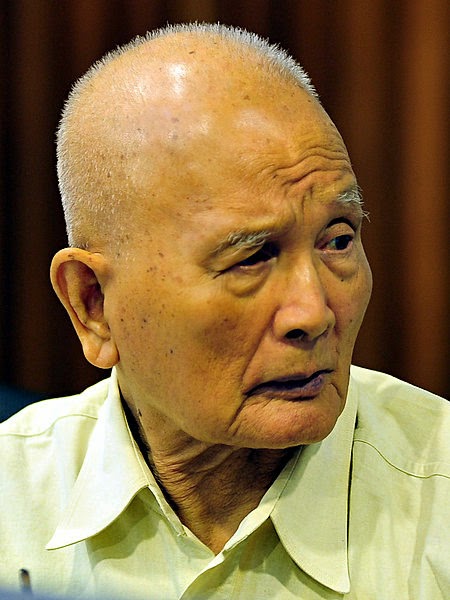
88 year old Nuon Chea (pictured) served as the notorious Pol Pot's deputy, while Khieu Samphan, now aged 83, was head of state. The judge said they were guilty of ‘extermination encompassing murder, political persecution, and other inhumane acts.’
The Maoist regime’s speciality was to drive people out of the cities and force into the countryside, where they were worked or starved to death. Many in Cambodia have criticised the slow pace at which justice has proceeded, and a judge resigned in 2012, complaining that investigations into suspects were being blocked.

The convicted pair deny the offences and say they will appeal, though they will remain in gaol. They could also face a further trial on charges of genocide.

Sunday, 9 March 2014

Ghosts of Asian disasters


Japan’s prime minister, Shinzo Abe (pictured), made an interesting appointment as a governor of the country’s NHK broadcasting organisation. Naoki Hyakuta has declared that Japan’s massacre of up to 350,000 civilians in the Chinese city of Nanking in 1937 never happened.

Mr Hyakuta has also written a best-selling novel, now turned into a film, glorifying Japan’s kamikaze pilots of World War Two. China and South Korea, which also suffered dreadfully at Japan’s hands, are both angry.


Ghosts are walking in Indonesia too. The Act of Killing, a film about the mass slaughter that accompanied the birth of President Suharto’s dictatorship in the mid-1960’s, has won a BAFTA award for best documentary. Perhaps half a million people were killed by death squads.

In 2012, the country’s human rights commission urged President Yudhoyono to make a formal apology, and called for the killers to be prosecuted. But the president, a former general, is the son-in-law of the then head of the army’s special forces, who was deeply implicated in the massacre, and the report has been largely ignored.

Wednesday, 6 April 2011

Bangladesh - war crimes trials stall

The war that brought independence for Bangladesh (then East Pakistan) ended in 1971. Estimates of the number of lives lost range up to 3 million – many murdered in cold blood by the West Pakistan army - and perhaps 10 million people fled their homes.


Over the last few months, there have been attempts to call to account some of those responsible for atrocities during the conflict. The authorities are not going after the West Pakistan army, but alleged local collaborators who helped them.


Dozens of suspects are banned from leaving the country, and the war crimes tribunal has issued arrest warrants against five party leaders, including two former ministers, though they are not charged with war crimes, and unfortunately, the whole process has become mired in inter-party political rivalries.


The general belief is that if the opposition wins the next general election, due in 2013, it will scrap the war crimes trials, and they are the favourites. No democratic government in Bangladesh’s short history has ever won a second term.

Friday, 11 June 2010

Held to account for Srebrenica

The International Criminal Tribunal for the Former Yugoslavia has just handed out its toughest ever sentences. Two security chiefs in the Bosnian Serb army, Vujadin Popovic and Ljubisa Beara, have both been convicted for committing genocide in the Srebrenica massacre, and sent to prison for life. Five other defendants were gaoled for between five and 35 years.

In April 1993, the UN declared Srebrenica a safe haven, but it was protected only by a small unit of troops. In July 1995, the Bosnian Serb army took the town. They bussed out all the women, and the men aged under 16 or over 65. The remaining men – nearly 8,400 of them - they massacred.

The Srebrenica massacre was the worst in Europe since World War Two. The court said that Popovic and Beara were acting under orders from General Ratko Mladic, who is wanted for trial but still at large.

The judgement also declared the massacre was part of "a widespread and systematic attack against a civilian population" begun on the orders of Bosnian Serb President Radovan Karadzic, who is now on trial before the tribunal at The Hague. See also my blogs of 16 October, 2009 and May 11, 2010.

Friday, 5 March 2010

Who remembers the Armenians?

“Who remembers the Armenians?” was supposed to have been Hitler’s scornful question as he tried to stiffen the backbone of his generals on the eve of the invasion of Poland. And the failure of the victorious allies of World War One to call anyone to account for the massacre of this Christian minority in Turkey was said to have made him believe he could, literally, get away with murder.

But 90 years on, the answer to Hitler’s question seems to be “quite a lot of people.” Yesterday, the US Congress’s Foreign Affairs Committee, despite pleas from Hilary Clinton, has declared that the massacre amounted to genocide.

Turkey had sent MPs to Washington to lobby against the resolution, and the country’s president, Abdullah Gul, has branded the committee’s decision "an injustice to history". It has recalled its US ambassador for consultations and hints that further sanctions may be on the way.

It is estimated that 600,000 Armenians were massacred and that another 400,000 perished from the hardships and brutality of forced deportations. Turkey accepts that atrocities were committed but argues they were a by-product of the Great War, in which Turkey fought on Germany’s side, and that there was no systematic attempt to destroy the Armenian people.

Wednesday, 23 December 2009

Guinea - "crimes against humanity"

Following the shooting of more than 150 protestors in September, Guinea’s military leader, Capt Moussa Dadis Camara, should be charged with crimes against humanity, according to a leaked United Nations report.

Critics of the military junta had gathered at a sports stadium in the country’s capital, Conarky, to demonstrate their opposition after reports that Capt Camara was planning to stand for president. Troops opened fire on them in what human rights groups claim was a premeditated massacre.

The UN’s investigators say soldiers also raped or sexually abused more than 100 girls and women, and that hundreds of other people were tortured or ill-treated. Capt Camara had claimed the atrocities were committed by unruly elements in the army.

Three weeks ago, he was shot in the head by one of his aides, then flown to Morocco for treatment. He has not returned, fuelling suspicion that he may have been seriously injured, though Guinea’s ambassador in Morocco claimed today that he plans to come back “as quickly as possible.”

Friday, 17 July 2009

Katyn

Just seen Andrzej Wajda’s film Katyn, telling the story of the notorious massacre of up to 22,000 Polish officers and others seen as part of the country’s elite, during World War Two. It happened after those two champion mass murderers, Hitler and Stalin, teamed up to partition Poland. The film is a gripping but dignified portrayal of the ordeal of those who were killed, and of their loved ones left ignorant of their fate.

The crime began to come to light after the tyrants fell out, and the Soviet Union found itself conscripted to the allied side by Hitler’s invasion. The Polish government in exile in London agreed to co-operate with Stalin, but when a Polish general asked for 15,000 p.o.w.’s to be transferred to his command, the Russians replied that most of them had escaped to Manchuria, and could not be found.

In 1943, the Germans announced that they had found the mass graves of nearly 4,500 Polish officers in the Katyn forest, near Smolensk in the USSR. The victims had apparently all been shot from behind. In a dramatic change of story, the Russians now said the Poles had been working in the area, and had been killed by the invading Germans in August 1941. A Red Cross investigation, though, produced evidence that the massacre had happened early in 1940 when the area was under Soviet control.

Still, the Soviet lie remained the official version of the story in Poland throughout the time the Communists held power. After they fell, the fiction was no longer maintained, and in 1990, President Gorbachev admitted that the Soviet secret police had been responsible. Wajda’s own father was killed in the massacre.

Monday, 18 May 2009

Sri Lanka - end of the end game?

Reports are emerging from Sri Lanka that the leader of the Tamil Tigers may have been killed along with his son as his forces mount what looks like a last stand in a tiny area in the north of the island. The government claims that tens of thousands of civilians have been allowed to flee over the last few days, but with journalists banned and the Red Cross – the only outsiders allowed access to the conflict area by the Sri Lankan government – having lost contact with its people, it is hard to form an accurate picture.

We do know that the United Nations is saying that 300,000 civilians have had to flee their homes in the last few weeks, and it believes that many of those who have escaped in the last few days need urgent medical treatment for wounds or malnutrition, while the Sri Lankan army says only a few need hospital care.

The Tigers’ fight for a Tamil homeland has cost 70,000 lives over the last quarter of a century, and many in Sri Lanka are relieved that it now appears to be over, but others are worried that the army’s campaign will have radicalised the Tamil minority, and that the Tigers may soon launch a suicide bombing campaign.

Meanwhile the UK and the UN have called for an investigation into allegations that the Sri Lankan forces committed war crimes by shelling civilian targets such as hospitals. See also my blogs of Jan 28, Feb 24 and May 11.

Monday, 13 April 2009

Labour anniversary + Indian massacre

It is 43 days since Labour’s deputy leader Harriet Harman announced on television that disgraced bank boss Sir Fred Goodwin would not be allowed to keep his £700,000 a year pension. The payment was “not going to happen.” The hapless Gordon Brown, she told us, had “said that it is not acceptable and therefore it will not be accepted.”

So what has Labour done in the six weeks that have elapsed since to keep their promise to the British people? Er, can’t think of anything offhand. Maybe they’ve just been too busy making up lies to try to smear opposition politicians.

On this day.....90 years ago, British soldiers opened fire on unarmed Indian demonstrators in the Jallianwala garden in Amritsar. The shooting went on for ten minutes, and at the end of it, according to official figures, 379 men, women and children lay dead, though some estimates put the real total at more than 1,000.

The officer in command, Brigadier-General Reginald Dwyer, was officially censured and resigned from the army, though the House of Lords passed a motion praising his conduct, and an appeal run by a British newspaper for him raised £30,000.

Thursday, 12 March 2009

Massacres by lone gunmen + Cardiff air crash

Two massacres by lone gunmen in the space of a day. A small town in Germany named Winnenden was the scene of one of them. Seventeen year old Tim Kretschmer walked into the secondary school he used to attend dressed in combat gear, and started spraying bullets around. He killed 8 girls, one boy and three women teachers. Then he left the school and shot three more people, before killing himself.

Earlier a 28 year old American shot dead his mother and burned down the house they had lived in in Alabama, and then went on a killing spree that left another 9 dead before he too shot himself.

We are used to hearing about mass shootings in the USA. The worst happened at Viginia Tech in Blacksburg on April 16, 2007 when Seung-Hui Cho killed 32 teachers and students before committing suicide. As usually happens in America, the massacre was followed by a great deal of hand-wringing then a bit of minor tinkering with the gun laws.

German Chancellor Angela Merkel pronounced the Winnenden shootings “incomprehensible.” Perhaps, but not unique. In April 2002, a 19 year old student who had been expelled from a school in the German city of Erfurt returned to kill 13 teachers, two students and a police officer before killing himself.

In Britain, we had the Hungerford massacre of 1987 in which Michael Ryan murdered 16 people, before killing himself. Then nine years later, Thomas Hamilton killed 16 small children and a teacher at Dunblane Primary School before turning one of his guns on himself. The tennis star Andy Murray, then aged 8, was one of the survivors. Both of these events were followed by severe tightenings of Britain’s gun laws.

On this day...59 years ago what was then the world’s worst civil aviation disaster happened close to the village of Sigingstone in South Wales. Eighty people were killed on a charter flight bringing home Welsh rugby fans from an international against Ireland. The full story is in A Disastrous History of Britain.