Showing posts with label collapse. Show all posts
Showing posts with label collapse. Show all posts
Monday, 6 January 2020
Election reflections: wakey, wakey Labour!
In the General Election, the Libdems' vote increased (by 3 times more than the Tories'), while Labour's vote collapsed, so Labour's Andrew Adonis used his New European column to call on the Libdems to disband! The NE has published the letter I sent in reply


Saturday, 15 June 2019
Brexitwatch: does the Tory Party face richly deserved extinction?
Is the Tory Party
heading for richly deserved extinction? At the Peterborough by-election the
Tories saw their share of the vote fall by 25 percentage points. At the
European elections, they won just 9 per cent of the vote. At the local
elections they lost more than 1,300 seats. Donations to the party have fallen
by half.
And the latest Private Eye reveals the picture is even
worse. Although the party appears to own a lot of property, such as
Conservative clubs and buy-to-let properties, very little is owned by the party
centrally.
Almost all of it is
in the hands of local associations and trusts, and those local associations are
starting to abandon the parliamentary party, with shedloads of local
officeholders backing the Brexit Party at the European elections. Now the fear
is that local branches will start giving up on the party, affiliating with Nigel
Farage’s lot instead, and taking the property with them.
Is this one of the reasons why we are getting unadulterated pandering to the party’s worst, most reactionary instincts from
those trying to replace Theresa May.
Monday, 21 December 2015
Deadliest building collapse of modern times - 24 accused on the run

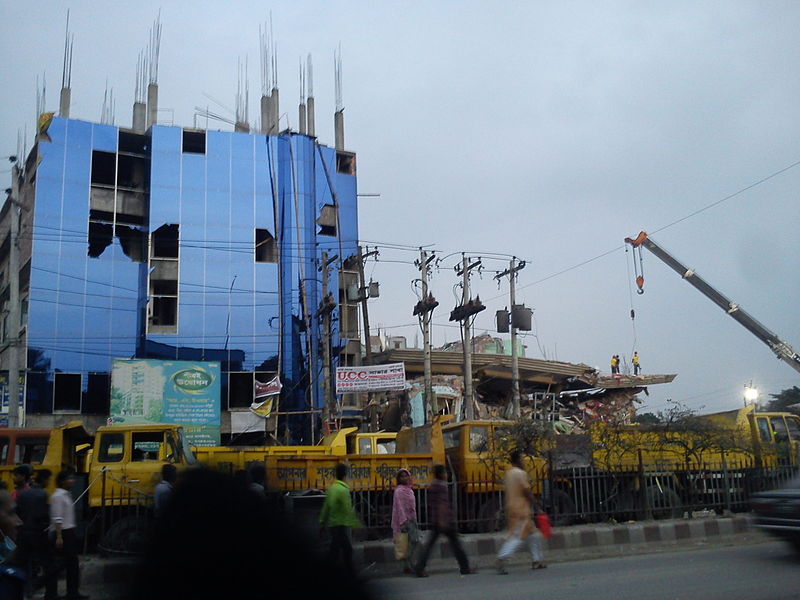
The Rana Plaza disaster of 2013 in
Bangladesh was the deadliest building collapse of modern times, costing the
lives of at least 1,138 people. More than 2,000 were injured, and some are
still not accounted for.
41 people were charged with murder
in connection with the collapse, but now 24 have absconded. A court has issued
arrest warrants, and ordered that their property should be seized. The owner of
the building, Sohel Rana, is still in custody. The trial is expected to start
by April.
The building on the outskirts of Dhaka,
originally constructed as a 6-storey shopping mall, had been converted into a
9-floor factory complex. It is alleged that workers drew attention to cracks in
the structure before it collapsed.
Bangladesh’s clothing industry
employs 4 million people, and makes garments for a number of well-known Western
names. (see also my blogs of May 20 and June 12, 2013, and June 1, 2015.)
Thursday, 24 September 2015
Another Hajj tragedy

All able-bodied Muslims who can
afford it are supposed to go to Mecca during the week of the Hajj at least once in their lives, but this year the event has again been marred by tragedy,
as 107 people were killed when a crane collapsed on top of worshippers
gathering outside the Grand Mosque.
The crane was operated by the Saudi
Binladin Group (some relation – it is run by Osama’s brother). The group has
been hired on a 4 year contract worth $27 billion to expand the Grand Mosque.
The accident happened during high
winds and heavy rain, and one of the company’s engineers said it was an ‘act of
God’, but the Saudi government’s official mouthpiece said the Binladin Group
had not ‘respected the rules of safety’, and the company’s directors have been
ordered not to leave the country.
At the Hajj in 1990, more than
1,400 pilgrims were killed in a fatal crush in a tunnel. Four years later, at
least 270 died in another stampede. A fire in 1997 killed 343, and further
stampedes in 2004 and 2006 killed another 580.
Monday, 1 June 2015
Rana Plaza collapse - murder charges

The owner of the Rana Plaza factory complex in Bangladesh
which collapsed in April 2013 with the loss of more than 1,100 lives has been
charged with murder. It was the deadliest event of its kind in modern times.
Sohel Rana and 41 others, including government officials, are accused
of ignoring warnings that the buildings, about 20 miles from the capital, Dhaka,
were not safe. Any convicted of murder could face the death penalty.
There has been criticism of the length of time it has taken to
bring charges, but investigators say they have had to take statements from more
than 1,200 people. It is said this is the first time anyone has faced criminal
charges over an accident in the country’s clothing industry, which is one of the
biggest in the world, and provides cheap items for some well-known Western
retailers.
It is alleged that three extra storeys had been illegally added to
the building. After the disaster, Mr Rana tried to flee to India. (For more
details, see my blog of 3 May 2013.)
Saturday, 21 December 2013
London theatre disasters

Last Friday (the thirteenth, of December) I was watching a play at the Apollo Theatre in London. Six days later, the ceiling fell in on the dress circle, where I had been sitting, injuring 76 people.
Still, that was not nearly as bad as some of the earlier disasters that struck the capital's theatres. The first Theatre Royal, Drury Lane, was burned down in 1672. The second was declared unsafe and closed, while the third lasted just 15 years before it too caught fire, and was razed to the ground in 1809.
In the 17 years from 1863, there were 14 major fires in London theatres, and the head of the Metropolitan Fire Brigade, Sir Eyre Massey Shaw, produced a report lambasting the inadequacy of their safety precautions.
Shaw was a great friend of the Prince of Wales, later King Edward VII, and would tip the prince off if there was a particularly 'good' fire, so he could tag along for a bit of amateur firefighting. One blaze at the Alhambra in Leicester Square almost cost the future king his life when a wall collapsed, narrowly missing him.
For more, see London's Disasters.
Thursday, 5 December 2013
Disasters and politics
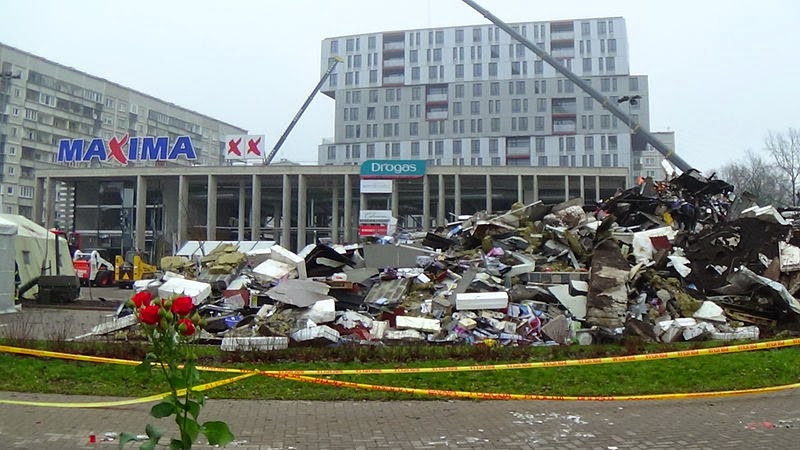
When the Maxima supermarket collapsed in the Latvian capital, Riga, last month, with the deaths of at least 54 people, (see my blog of Nov 22) it also brought down the government. Prime Minister Valdis Dombrovskis resigned after the president, Andris Berzins, described the disaster as ‘murder’.
Disasters often have important political consequences. The Bangladesh cyclone of 1970 was the deadliest in history, killing up to a million people. It was also the last straw in the fractious relationship between East and West Pakistan. The response of the government in the West was seen as grudging and inadequate, and the East began a war of independence from which it emerged as the new nation of Bangladesh.
In 2008, another cyclone, Nargis, killed perhaps 140,000 people in Myanmar. Again, the government was heavily criticised, for the slowness of the relief effort and its reluctance to accept foreign help. Many saw this as the beginning of the current transition to democracy.
Going further back into history, a devastating hailstorm that flattened crops across much of France in 1788 played a crucial role in fomenting the Revolution that came the following year, as it bankrupted the government through loss of tax revenues, and sent food prices into the stratosphere.
Friday, 22 November 2013
Latvian supermarket collapse
At least 32 people have been killed after the
roof of a supermarket collapsed in the Latvian capital, Riga. Three of the dead
were emergency workers, and there are fears that more people could be trapped
inside. It is the country’s worst disaster since it gained independence from
the Soviet Union in 1991.
The supermarket won an architectural prize
when it opened just a couple of years ago, and the cause of the collapse is
unclear, though there are reports that a garden was being built on the roof.
Police are investigating to see whether there have been any breaches of
building regulations.
Relatives have been asked to call the mobile
phone numbers of those still missing to help rescue services locate them
in the rubble. Witnesses said customers tried to run out when the roof started
to collapse, but that the supermarket's electronic doors closed, trapping them
inside.
Probably the deadliest store collapse of all
time happened in the South Korean capital, Seoul, in 1995, when the five-storey Sampoong
department store collapsed, killing 501 people. A police investigation revealed
that it had been built with sub-standard cement and had been inadequately reinforced.
For the full story, see A Disastrous
History of the World.
Wednesday, 12 June 2013
Bangladesh factory collapse - inspectors suspended

The Bangladesh
government has suspended seven inspectors who it claims were negligent in their
oversight of clothing factories in the Rana Plaza building which collapsed in
April, killing more than 1,100 people.
An official said
the inspectors never visited five of the factories and that one had been operating
without a licence since 2008. A government investigation has blamed the use of poor
building materials for the collapse of the block.
Over the last
few years, the number of factories in Bangladesh has soared to more than
240,000, but there are only 50 inspectors.
The clothing industry alone employs more than 3 million workers, mainly
women from poor villages.
The Rana Plaza’s
owner and five executives and owners of factories housed in the building have
all been arrested, but no formal charges have yet been brought.
Monday, 20 May 2013
Great disasters - great escapes

With a death
toll of more than 1,120, the fall of the Rana Plaza in Bangladesh is now
confirmed as the deadliest building collapse in modern history, but in the
midst of terrible tragedy, there was an astonishing story of survival.
Nineteen year
old Reshma Begum was pulled from the rubble alive after being trapped for 17
days. Rescuers had spotted her waving an aluminium
curtain rail. Reshma had come to the
big city from the countryside three years ago, and had been working at her
factory in the Rana Plaza for less than a month when the block collapsed.
Three
years ago, a 24 year old man was dragged out of the remains of a hotel eleven
days after the Haiti earthquake, and 17 days after the collapse of the Sampoong
department store in Seoul, South Korea, in 1995, an 18 year old was found
alive.
In 1906, nearly
1,100 miners were killed by an explosion in a colliery at Courrieres in
France. To the astonishment of rescue
workers, 20 days later, a group of 13 survivors emerged. They had kept themselves alive on
food that miners took down the pit to eat during their breaks and by slaughtering
a horse.
*My third video on Britain's 20 Worst Military Disasters is a story from Scotland - https://www.youtube.com/watch?v=IKR5Ayyx6cs
Friday, 3 May 2013
Bangladesh factory collapse now deadliest of modern times

The collapse of
the Rana Plaza factory building near the Bangladeshi capital, Dhaka, is now
confirmed as the deadliest event of its kind in modern times. Officials say the death toll has now reached
507, but that scores of people have still not been accounted for.
About 2,500
people were injured as the 8-storey building fell, and rescuers say they do not
know how many are still missing because they have not been able to get accurate
figures from the factory owners. Nine
people have been arrested in connection with the disaster.
Ever since the
Rana Plaza collapsed last week, workers in Bangladesh’s huge clothing industry
have been holding protests to demand better safety standards.
Until now,
the deadliest building failure of modern times was the collapse of the Sampoong
department store in Seoul, South Korea in 1995, in which 501 people died. When
part of the Circus Maximus in Rome collapsed during a gladiator fight some time
between 138 and 161AD, it was said to have cost more than 1,100 lives.
*The second in my
series of videos on Britain’s 20 Worst Military Disasters – the defeat of
Boudicca. https://www.youtube.com/watch?v=mR7U4cjenuQ
Sunday, 28 April 2013
Bangladesh building collapse - owner arrested

The owner of the factory building that collapsed last Wednesday in Bangladesh’s capital,
Dhaka, killing hundreds of people, has been arrested by soldiers from the
country’s Rapid Action Battalion at the border with India.
Five other people have also been detained - 3 owners of clothes factories
that were housed in the Rana Plaza and 2 engineers. Two more survivors have been pulled from the
rubble today, but altogether about 360 people are known to have died.
Police said officials had ordered an evacuation of the block on Tuesday
after cracks appeared, but that the factories ignored them, while municipal engineers
are reported to have declared the building safe the day before it collapsed.
Bangladesh has one of the biggest clothing industries in the world,
providing cheap products for well-know Western retailers, but it has been
widely criticised for low pay and dangerous conditions.
* Now available in paperback – Disaster!
A History of Earthquakes, Floods, Plagues and Other Catastrophes. http://www.barnesandnoble.com/w/disaster-john-withington/1111579925?ean=9781620871812
Monday, 8 April 2013
Indian building collapses
Nine people have
been arrested in India in connection with the collapse of a high-rise block of
flats in Mumbai last week. 74 people
were killed.
The nine, who
include builders, police officers and local officials, are alleged to have paid
bribes to police and municipal officials so they could put up the building
without official sanction. They may
face charges of culpable homicide and causing death by negligence.
Even though work
is said to have started on the block just six weeks ago, seven floors had
already been completed, and people had been moved into some apartments. Most of the dead were poorly paid
construction workers and their families.
India has
suffered a number of deadly building collapses in recent years. In November 2010, a 15 year old block of
flats in New Delhi came down as an additional storey was being added. At least 67 people, mostly poor migrants, died.
*I am posting a series of videos on Britain’s
20 Worst Military Disasters. This is the
first. https://www.youtube.com/watch?v=D0Bgf-xHHGE
Friday, 9 November 2012
Store collapses
A search is still going on for any survivors in
the Melcom store building in Ghana’s capital, Accra, 48 hours after it
collapsed, amid reports of voices being heard from the rubble. So far 9 bodies have been recovered, and 69
people taken out alive.
Officials from Ghana's National Disaster Management
Organization have said the building had poor quality foundations, and Ghana’s president,
John Dramani Mahama, has said anyone found to have been negligent ‘will pay a
price’.
A property developer who had been wanted for
questioning has given himself up, declaring: ‘There is no way I will put up a
building and do shoddy work.’ The
president has declared the site a disaster zone and suspended his campaign for
next month's elections.
Perhaps the deadliest store collapse in history
happened at the Sampoong department store in Seoul, South Korea, in 1995. Cracks had been appearing in the structure
for weeks before it crashed down, causing the deaths of more than 500 people.
Saturday, 5 June 2010
Bangladesh's worst fire
The fire that swept through a densely populated area of Bangladesh’s capital, Dhaka, is the worst to have hit the country since it became independent in 1971. At least 120 people have been killed in the ancient buildings and narrow alleys of the Kayettuli district.
It is believed that an electrical transformer exploded after heavy rain, and that the fire was then fuelled by chemicals stored in illicit improvised factories in the area. Flames were said to have leapt six storeys high.
The authorities say that many buildings did not have proper fire escapes, that fire engines could not get down the narrow streets and that there were no hydrants for firemen to get water to fight the flames. Some victims were taken to hospital in rickshaws by local people.
Only on Tuesday, a five storey building collapsed in Dhaka, killing at least 25 people as it crashed down on slums below. The structure had been built on swampy ground, and police say it had then been modified without approval from the authorities.
It is believed that an electrical transformer exploded after heavy rain, and that the fire was then fuelled by chemicals stored in illicit improvised factories in the area. Flames were said to have leapt six storeys high.
The authorities say that many buildings did not have proper fire escapes, that fire engines could not get down the narrow streets and that there were no hydrants for firemen to get water to fight the flames. Some victims were taken to hospital in rickshaws by local people.
Only on Tuesday, a five storey building collapsed in Dhaka, killing at least 25 people as it crashed down on slums below. The structure had been built on swampy ground, and police say it had then been modified without approval from the authorities.
Monday, 28 December 2009
Indian bridge collapses
Up to 49 building workers are feared dead after the collapse of a section of a new 100 yard bridge across the Chambai River in Rajasthan, northern India. Some of the victims were flung into the river and others buried under rubble.
The bridge was a joint enterprise between an Indian and a South Korean company. Police have arrested two project managers, and have filed charges against another dozen company officials.
India has suffered a number of bridge collapses in recent years. One of the deadliest happened near the town of Veligonda in Andhra Pradesh in October 2005, when a flash flood swept away a small bridge, and an express train was derailed killing at least 114.
In December 2006, a dozen railway passengers were killed when a bridge collapsed onto a train passing beneath at Bhagalpur in Bihar, while nine months later, in September 2007, up to 30 people died when a flyover being built in Hyderabad gave way.
The bridge was a joint enterprise between an Indian and a South Korean company. Police have arrested two project managers, and have filed charges against another dozen company officials.
India has suffered a number of bridge collapses in recent years. One of the deadliest happened near the town of Veligonda in Andhra Pradesh in October 2005, when a flash flood swept away a small bridge, and an express train was derailed killing at least 114.
In December 2006, a dozen railway passengers were killed when a bridge collapsed onto a train passing beneath at Bhagalpur in Bihar, while nine months later, in September 2007, up to 30 people died when a flyover being built in Hyderabad gave way.
Saturday, 16 May 2009
A bonus for the taxpayer + decline and fall of Ronan Point
Maybe we, the people, are getting a bonus for a change. Yesterday Jack Straw, the alleged “Justice Secretary”, dropped his plans for secret inquests that might have allowed the government to suppress the truth about incidents like the shooting of Jean Charles de Menezes.
Mr Straw, of course, is rather hobbled at present after it was revealed that he had charged us taxpayers double the amount of council tax he was actually paying on his second home. With so many of Mr Straw’s “Labour” colleagues under a cloud, let’s hope they’re all feeling a little abashed. After Iraq, years of systematic destruction of our civil liberties, the invention of 3,000 new crimes, 24 hour drinking, super-casinos etc, “a period of inactivity from you would be most welcome”, as Clement Attlee, a real Labour politician, might have put it.
On this day....41 years ago, a section of a brand new 23-storey block of flats called Ronan Point in East London collapsed. One couple in their sixties were awoken by a dreadful ripping sound as their bedroom wall fell away, and they found themselves lying in bed two feet from an 80 foot drop.
It was caused by a gas leak and explosion on the 18th floor. Miraculously, only five people were killed, but the accident raised severe doubts about the industrial building system used at Ronan Point. The block was repaired and people were moved back in, but in 1986, it was demolished. For the full story, see The Disastrous History of London.
Mr Straw, of course, is rather hobbled at present after it was revealed that he had charged us taxpayers double the amount of council tax he was actually paying on his second home. With so many of Mr Straw’s “Labour” colleagues under a cloud, let’s hope they’re all feeling a little abashed. After Iraq, years of systematic destruction of our civil liberties, the invention of 3,000 new crimes, 24 hour drinking, super-casinos etc, “a period of inactivity from you would be most welcome”, as Clement Attlee, a real Labour politician, might have put it.
On this day....41 years ago, a section of a brand new 23-storey block of flats called Ronan Point in East London collapsed. One couple in their sixties were awoken by a dreadful ripping sound as their bedroom wall fell away, and they found themselves lying in bed two feet from an 80 foot drop.
It was caused by a gas leak and explosion on the 18th floor. Miraculously, only five people were killed, but the accident raised severe doubts about the industrial building system used at Ronan Point. The block was repaired and people were moved back in, but in 1986, it was demolished. For the full story, see The Disastrous History of London.
Subscribe to:
Comments (Atom)